

The term “spatial problems” means not only difficulties in knowing right from left, but recognizing that “was” is not the same as “saw” or “b” the same as “d.” When teachers or those who test children use the term “spatial problems,” they mean not only the above, but also those children who crowd all of their arithmetic problems to one side of a page when they’re doing their homework-or get mixed up when trying to follow directions-or get lost when they are in a new place or who don’t know how to write certain words, letters, or numbers. Spatial problems also can relate to the degree of disorganization in a child’s room.
Most children will get “left” and “right” mixed up until they are about seven years old. But somewhere around age five or six, most children, given the proper opportunities, will begin to be able to identify the right and left sides of their bodies.
Start with your child’s room. Clean up the clutter. Put things away. Encourage orderliness. If there is order to the rest of the house, chances are that your child will imitate that orderliness. Scolding won’t correct the situation unless there are guidelines and. in this case, it’s what die child sees around him. Helping the child to keep his I space, in his room organized may mean, at least initially, a fair amount of picking up by parents, but eventually, like cleanliness, the child will get the message and grow used to orderliness just as he does to cleanliness and will feel uncomfortable without it.
Have clearly defined places for things. And keep the directions simple. “Clothes go here. Books go there. Comic books over there, etc. – Provide plenty of drawers and shelves. Convenient storage boxes can be obtained for things with lots of movable parts-blocks, puzzles, and games. In this way pieces of games or puzzles can be kept separate one from another and will be used. There is nothing more discouraging than a heap of games with all of the pieces jumbled together. The child will simply ignore them
Play “directional” games with your child. Young children, especially preschoolers, like to play games in which they point to parts of their body-for example, “Show me your hair, now your knee, now your thumbs.” This should progress to games that name sides, such as “Show me your right elbow. Now show me your left foot. Now wiggle your right hand. – The importance of this type of identification cannot be overemphasized. Every possible opportunity should be taken to teach and reinforce this ability.
Incorporate directional words in your conversations with your child. For example, on the way to school or to the grocery store, say, “Lees see. 1,11 make a right turn at this comer. Now I’ll make a left turn, etc. See if your child can begin to anticipate the direction of the turn. Say, “We are going to turn this way (point) at the next corner. Can you tell me what direction (left or right) that is?” If he gets confused, you ten him the direction. And treat it lightly.
An excellent place to deal with spatial problems is the local supermarket. As you and your child push the cart up and down the aisles, incorporate directional terms into your conversation in an incidental way-something like, “While I am getting the bread, you go down that aisle and turn left-that way (Point)-and pick up a quart of milk. Then we’ll meet back here.”
Now and then your child will be leaving the house by himself, perhaps to catch the school bus or go to Jimmy’s house down the block. Now and then ask, “Will you be turning right or left when you go to
This technique can grow boring to the child if used too frequently, but it can be effective when used sparingly.
Give your child things to do that require placement of objects to the right or left of something. “Jimmy, put those books to the left of the stove” or “Susie, is the tape recorder to the right or to the left of the flower pot?” or “Where shall we plant the bush-on the right or the left of the tree!” There are many other directional words that can be used again and again with the child: over, under, in front of, behind, on top Of, in, out, above, etc.
If your child’s homework looks messy, talk with your child’s teacher and ask about the possibility of ruling spaces on his paper. For example, if your child tends to write from one edge of the paper to the other, leaving no margins, rule in margins. But rule them in lightly so that they – 7 be seen by the child but erased, if necessary, when the assignment. Completed – The same approach can be used for arithmetic sheets. Rule off spaces, one for each problem. The space provided should be generous but not excessive. In fact, if you can get your child to rule off his own papers, you’ve made a big step forward and so has he. Chances are that ruling off space will soon become unnecessary.
Play a game in which you hide an object, and the child must find it. You begin the game by saying, “I have something hidden (in this room or here in the yard). You can find it only by following the directions I give you. Take three steps forward. Now turn to your right. Take two steps. Now turn to your left and take two steps. Now take three steps forward.”
A variation of this activity is to let the child hide something and direct you to locate it. A simple rule of the game might be, “No more than two steps in any direction without changing directions.”
Make some sheets of arrows. You can easily, inexpensively, and quickly do a group of them. (If you use only one sheet, the child may memorize the page, so a selection of sheets alternated at different times is best.) Use a standard sheet of 8 1/2 x 11 paper or cardboard. Draw a series of arrows pointing either up, down, right, or left. Time your child on how quickly he can call off, in sequence, which way the arrows are pointing.
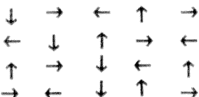
There are a number of variations to this activity. For example, as the child calls out the direction, he will incorporate arm movements: left (left arm outstretched); right (Tight arm outstretched); up and down (both arms stretched up or down). Once the child has mastered this activity, ask him to give a single jump while calling out the directions and making the appropriate arm movements. The jump should occur at the same time the direction is called out. If this is too difficult, eliminate the jumps until later.
A poor understanding of space can even affect a child’s ability to read from left to right. Talk with your child’s teacher about allowing him to use the index finger of his preferred hand to “track” the words across the line of print as he is reading. Not only will it help him to organize space, but it will strengthen left-to-right movements of the eyes across the page. When you are reading to your child (and it is hoped that this is a frequent occurrence in your home), track the words with your finger to show him that reading occurs from left to right.
Observe your child as he does everyday tasks. One of the reasons a large number of children continue to have spatial difficulties is because many times, for unclear reasons, they haven’t developed a “preferred side” by the time they are seven years old. By “preferred side,” psychologists mean that children will, the majority of the time, drink with, open doors, comb their hair, brush their teeth, draw, write, toss a ball, et cetera, with the same hand. When the child switches hand usage for major tasks that clearly require only one hand, you should speak with your child’s teacher or the school psychologist to determine whether special remedial needs are being met.
As with other things you do with your child at home, keep the activities low-keyed, enjoyable, and non-threatening. Be gentle, take it one step at a time, and don’t scold. Your attitude will rub off on the child. If you seem to be having fun with the various games, your child will enjoy them, too. Set a goal-for example, “I want him to get to know what his right side is” and approach it in as many creative ways as you can think of. You will probably be amazed at the many ideas that will occur to you.
Keep in touch with your child’s teacher. (She may have some helpful ideas, too.) Let her know what you are doing and what gains or problems-you are seeing in your child.